A blog about miniatures, wargaming, and the people driven to ruin by them....

Friday, November 1, 2013

Shipwreck! Race to the Future!

 
Howdie.

I have decided to do a little modernizing of my PLAN fleet, by making a small purchase from Shapeways.  I have no personal experience with these, but they have been recommended to me several times.

What I should shortly receive are:

1x Type 051B Luhai (Shenzhen)
1x Type 051C Luzhou (likely the Shenyang)
2x Type 052B Luyang (Guangzhou and Wuhan)
4x Type 054A Jiankai II (not sure, but probably 2 for East and 2 for South)

Once they arrive, I will post a review, and follow up as they are painted and based.  I look forward to their support of my *classic* 90's vintage PLAN.  However, with these new vessels, I will have to try harder to not lose them as easily as my older stuff.

Hen hao!

Chalfant "Hen Mang" Conley

Wednesday, October 30, 2013

Book Review: The Imperial Cruise

Howdie.

I have decided to spread my book review out rather than clump them together. 

Today's book is "interesting" to say the least...

The Imperial Cruise, James Bradley.  If you don't have a copy of Flags of Our Fathers, I suggest you get a copy now.  Personally, I say get a copy of Flyboys too.  I won't say everyone needs a copy of The Imperial Cruise.

This book is about Taft's pivotal journey to the Pacific, and US relations with Japan, China, Korea, and the Philippines.  If you are not aware, there are some significantly ugly chapters in American history during this period.  This book seems a natural extension for Bradley as it searches for the seeds of the war in the Pacific that was to come later (and involve his father).  If you are a fan of Theodore Roosevelt, Bradley will strip the veneer off of Teddy and expose some unpleasant truths.  Of course, none of this is a secret, or a surprise.

However, any time someone does this, there are cries of revisionist history, and selective history, and "it was the time".... you either buy into that or you don't.  Bradley is not fabricating truths here:  these things happened (maybe I can't substantiate every individual claim he makes, but he is definitely correct in general).  Its shameful ... even if other nations were just as bad, or worse, in some of their actions.

On the other hand... Bradley really meanders around.  I actually like the anecdotes about Alice Roosevelt, and the rest of the Roosevelt family.  Its just that its hard to remember exactly what story Bradley is trying to tell you as he bounces from one topic to the next.  The reader is left with the feeling that the story of Taft's trip is really just a backdrop to attacking Roosevelt... not that he doesn't deserve criticism!  Far from it.  Just that very little of the book is committed to discussing what I thought was the central point.

There are some charming bits in here, such as a negative opinion of Roosevelt, who apparently was accused by political rivals of "sucking the knob of an ivory cane"... which... if you don't understand, I am not going to explain to you. 

I found the book interesting, and some of this is obviously quite well researched, it just feels confused and disjointed.  If nothing else, its an attempt to shed light upon a very dark chapter of American history.  If this subject interests you, find a cheap copy for your library.  Don't pay full price for this one.

Shipwreck! Convoy Ambush in the South China Sea

Howdie.

We just finished another game of Shipwreck, this time working through an actual scenario set up.  Our situation is the PLAN deciding to take action against a USN escorted shipping lane.  The USN defenders were bound to not attack the PLAN until 1) they or the merchants were attacked or 2) any PLAN vessel closed within a certain distance.

The PLAN were given some initiative by this set up, and with some careful planning, could perhaps strike a lethal blow against the running dog capitalists.

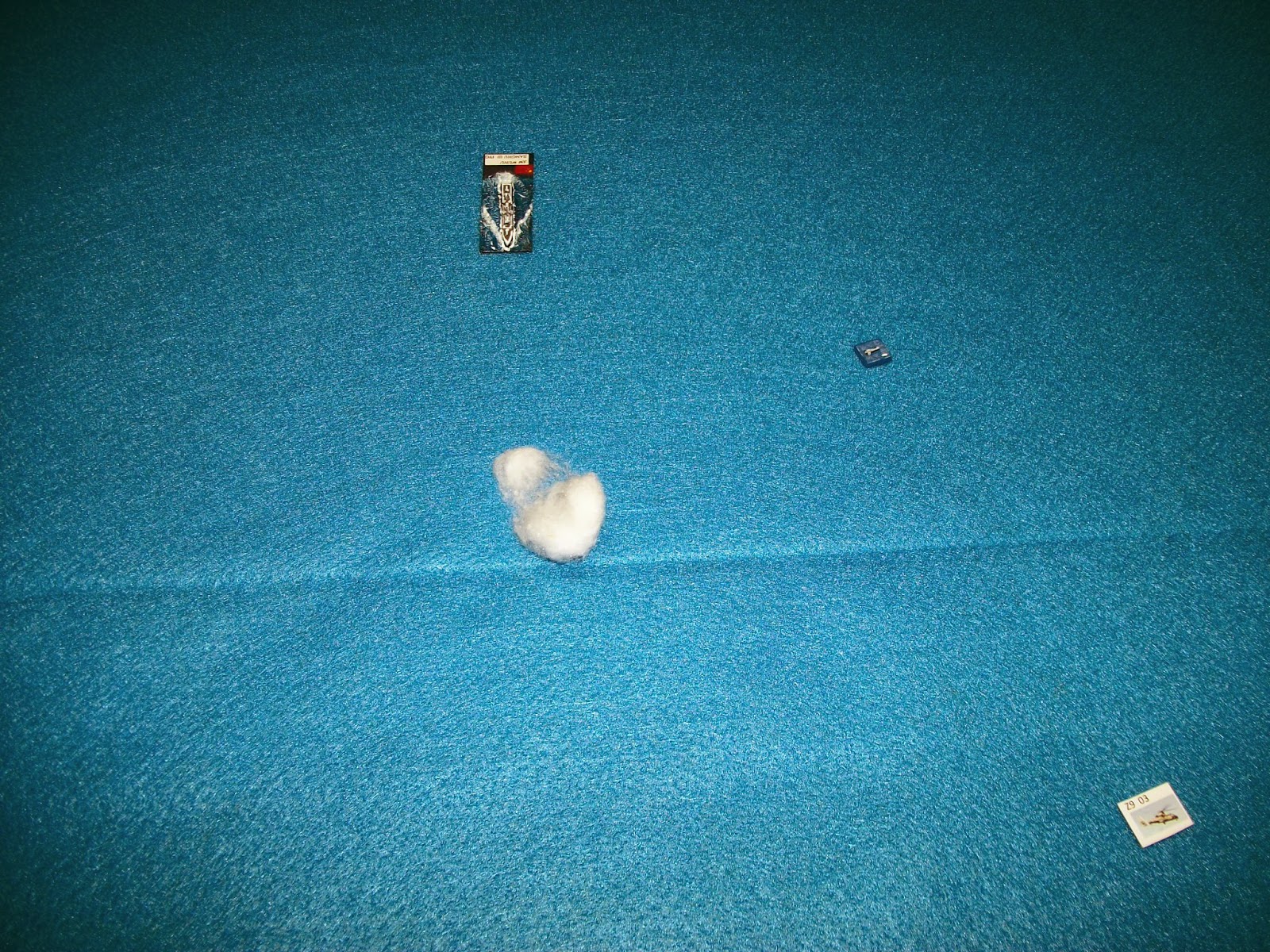
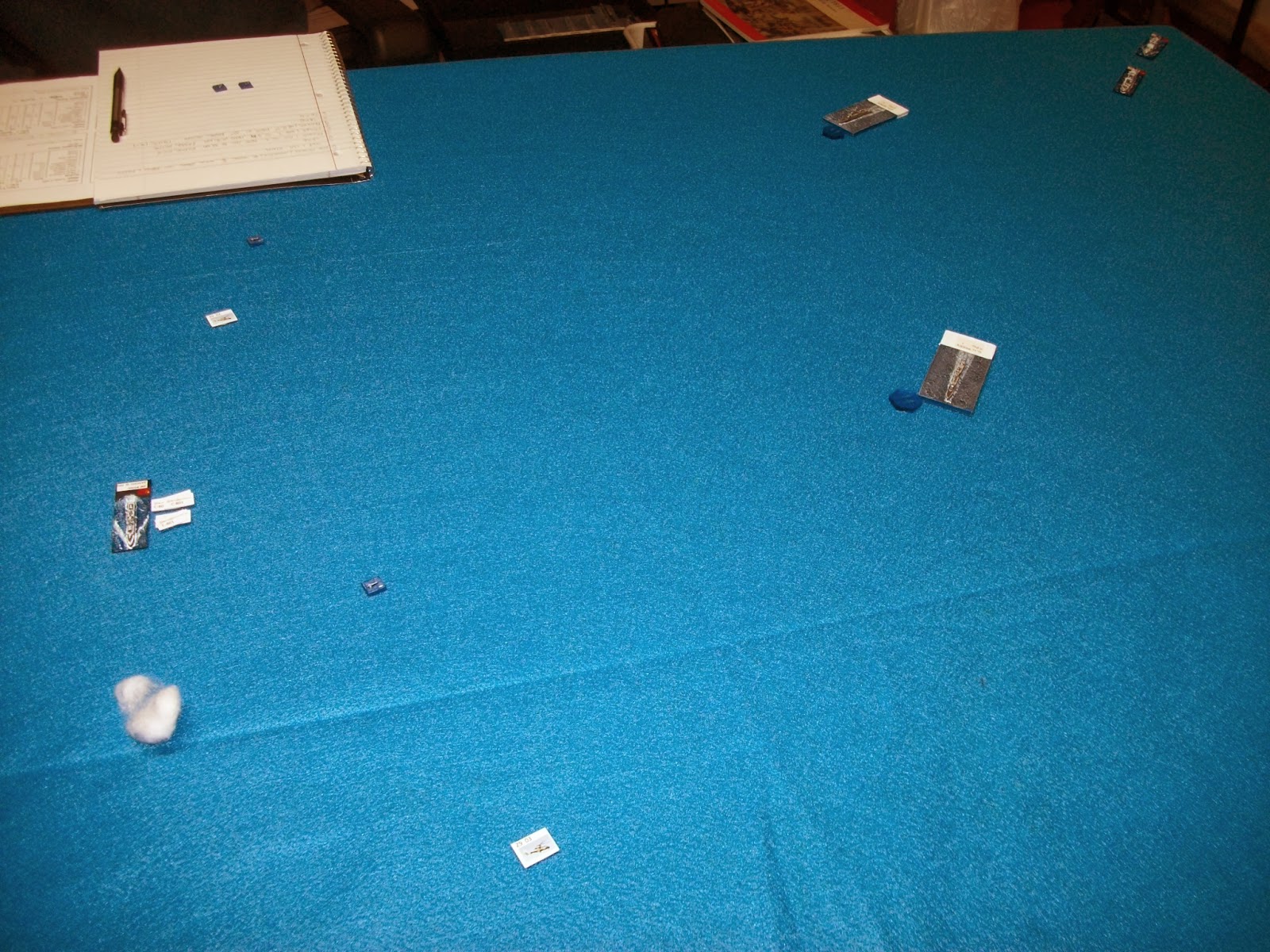
We used contact counters, to add a little mystery.  We had to ad lib a method for detection rolls (the EW modifier could be a giveaway)... here my PLAN vessels steam ahead, with a Z-9 to the fore.

You can see the unknown USN and merchant ships beginning to arrive as I attempt to close.  Detections start early, as the Qingdao (a Luhu DDG) is revealed.
The PLAN make detections too, revealing an OH Perry and a merchant ship... strangely, the merchant ship looks familiar (my USN opponent forget his commercial fleet, so my PLAN replenishment ships stood in).
As we close, my other ship, the Wu Hu (Jianghu III FFG) is revealed.  With an opportunity to close without being destroyed, the Qingdao begins to unmask weapon systems.  I made the decision to attack as soon as possible with the Qingdao.  I would remember this decision later.  I launched 6 C-802... 3 at the revealed OH Perry and 3 at the revealed merchant...
Of course the OH Perry (statted as an earlier, well armed, version) began to detect and engage missiles as they closed...
...taking them down...
 ... and down... until only a final missile struck the merchant, doing NO DAMAGE!!!!
 In the next turn, two more ships arrived, detected and revealed as a 2nd OH Perry and another (again, familiar looking...) merchant.
 But somehow the Wu Hu slipped back into a state of non-detection (which was remarkable, even with its high EW rating).
The Qingdao decided to turn further, in an attempt to unmask its primary AA system, the Crotale.  I began to regret my decision to attack with only 1 ship, as Harpoons closed in...
...from both OH Perrys.
The Crotale worked, downing 2 of the incoming Harpoons.
That still left 2 Harpoons to impact the Qingdao, which suffered a Crippling hit.  All engines stop, all systems down.  Lets hope the repair roll next turn goes well.
It doesn't, resulting the in the Qingdao sinking.  Unencumbered by emotion, the Wu Hu assumes a firing position as it has now closed the distance to the imperialist aggressors.
 
The Wu Hu, sensing impending doom, fires its full complement of C-801, while each OH Perry fires a pair of Harpoons.  With no real AA defense other than useless 37mm guns and a good EW rating, the Wu Hu would stand little chance of survival.
 Still, it behooves the soul to try.
With a large volley at a single ship, even with help from its sister, the targeted OH Perry looks to be in trouble.
But so does the Wu Hu. 
 Impact.  The OH Perry takes hits...
 ... and promptly sinks.
 I believe there was a miss, and a no damage from the Harpoons, but that was not enough luck...
 ... and the Wu Hu slipped below the waves.

So what was the conclusion?

The sinking of a USN vessel, even with the loss of 2 PLAN vessels, could be a huge propaganda victory for the Chinese... except that the Chinese ambushed the USN.  American public opinion might swing into a more warlike mood over the sneaky attack.

The merchants, shaken (especially the one with the minor hit) by their experience, would get through.  Unless a sub might show up in their way....

As the PLAN player I declare this to be a USN victory.  The merchants were (basically) unharmed, and though the loss of the OH Perry should have been prevented, the American people will be willing to see this conflict through.  Hopefully it will be limited to naval engagements until such time the diplomats can force both parties to break off actions.

Still... it was nice to sink an enemy ship :)  As the PLAN commander, I was concerned about getting too close (and losing my chance at the sneak attack).  I feel I made a huge mistake in not waiting for both of my ships to be in range, so they could unleash a coordinated attack.    Had I done so, I feel I would have  taken out the lead OH Perry and merchant, and possibly made my escape unscathed.  In a campaign setting, I have now lost my advantage of the sneak attack and can only hope the loss of one USN FFG weighs heavier upon the minds of my foes, than the loss of a PLAN DDG and FFG does upon my nation.

Wednesday, October 23, 2013

Book Reviews: Fox Two, Blue Berets, ... and Predator Cold War

Howdie.

Part two of my month of book readings begins here....

Fox Two:  The Story of America's First Ace in Vietnam, Randy Cunningham and Jeff Ethell.  Now, Jeff Ethell was also the author of Air War South Atlantic, which I also read this past month.  I will begin by saying that I don't think that Fox Two is written as well as Air War South Atlantic... but, it is informative, technically sound, and still interesting.

The paucity of American aces in Vietnam was due primarily by the lack of targets for American pilots.  It was also the result of the direction American fighters and fighter pilot training had gone... by focusing on missiles and missile platforms, American pilots lost their dogfighting ability.  I digress..

"Duke" Cunningham and his RIO Willie Driscoll earned their five victories during Randy's second tour, late in the American phase of the war.  The book covers in detail the types of missions that were flown, some of the workings of a US carrier at this time, the aircraft that were flown, what weapons were used... and Randy's personal feelings about everything.  He certainly was not fond of Jane Fonda, American press, or the anti-war movement.  On the other hand, he remarked several times how much he appreciated the efforts of the enlisted crews supporting him and his aircraft.  Its commendable to see this ace acknowledge the often overlooked work carried out by enlisted personnel... and pleasant to read how happy they were when "their" pilot downed his MiGs.

You certainly get a feel for the bleakness of the US air war in Vietnam, a war primarily fought by the pilots against SAMs and AA guns.

This book was short, and didn't seem to be as "professionally" written as others I have read.  I won't call it a great book, but it is worth reading (I picked up my copy for a quarter at a yard sale)... though I do feel I have to mention, that this American ace would eventually end up in serious legal trouble many years later.  Here in Vietnam at least, he had his moment, and deserves this recognition.

Inside the Blue Berets, Steven Zaloga.  If you are a wargamer, its quite likely you have a book or two from Zaloga.  This is the first non-Osprey of his I have read.  Its a large book, chronicling the development of the Soviet (then Russian) airborne forces, known as the blue berets.  Its well written, informative, and I learned several new things.  However....

It's almost like its two books.  Not that Zaloga divided it that way, in fact, I get the feeling that it is not his fault at all.  The first part of the book details the initial stages of the airborne, through all of their WWII actions.  I think the problem is Soviet records, perhaps also because these were written under Stalin's rule.  Its just simply what planes were used, where they were dropped, and how many were killed in losing the battle.  Because, essentially, they lost almost every drop battle apparently.  This large section of the book has some interesting parts, and might be useful for mapping out these WWII combat drops... but it just doesn't have a lot of detail, and I found parts of it boring.

Then, as the book gets to the 1950's and 1960's, the information is deeper, more detailed, more thorough.  It must be the available records being more complete, and less censored than under Stalin.  Whatever the reason, from here to the end, suddenly this is a great book to have on the shelf.

Here the actions of the VDV in putting down revolts in Eastern Europe coincide with the development of airborne equipment (ASU-57 to ASU-85, BMD, aircraft, helicopters).  Zaloga makes a strong case for why the Soviet government would turn to the VDV as its "Imperial Storm Troopers" whenever the need for action was desperate.  In short, the blue berets were capable and reliable... unlike most other units in the Soviet army.  Since they were so small in comparison to the rest of the army, the Soviets were able to gamble on new ideas and equipment (being a small portion of their spending).  The most expensive programs were for aircraft... which could be used for other things as well.

The book continues through Afghanistan, explaining different tiers of Speznatz (and why we are confused about what this means), the coups of the 1990's, and the dissolution of the Soviet Union.

For someone interested in the Cold War, or the VDV, this is a good book to have.  If you get a copy, and find the beginning bogging down (maybe, for you, you will like it better than me), I think you will still enjoy the latter half.

Predator:  Cold War, Nathan Archer.  I do read fiction, science fiction, and fantasy.  This is a novel dealing with the alien hunters, the Predators, crashing in Siberia, and fighting Russian soldiers and scientists.  Sounded interesting, and for a quarter, why not?

Short version of the review:  it sucked.  Not particularly interesting, not well researched (technically written ok, but writing about police, spies, and soldiers... it shows when you don't know what you are talking about), not worth the time to read, not worth a quarter to buy.  But, it was one of the books I read in the past month, so I included it in my review.

Okay then, there it is.  I think I will try to review books again in a few weeks.... for better or for worse!

Thanks for reading.

Chalfant

Tuesday, October 22, 2013

Book Reviews: One Hundred Days, and Air War South Atlantic

Howdie.

I started lambasting my local club with my opinions on recent readings... at some point, I realized they may not be able to bear that burden alone.  Then I thought, what better place to blab about books to total strangers than on my blog?  Its old tech meets new tech... sort of.   The reviews are completely subjective, and entirely debatable.  Still, this may be something I continue to do with the blog, a monthly wrap up of what I have read.  Be warned.... I get very wordy, and sometimes preachy.

For the past month, I have five books to mention, this post will deal with the first two.

One Hundred Days:  The Memoirs of the Falklands Battle Group Command, Admiral "Sandy" Woodward.  I consider myself fairly well read on the Falklands, but it has been many years since I last read a "new" book... and this was "new" to me.  I found it to be quite easy to work through, interesting, and pertinent.  Admiral Woodward wrote candidly about his experiences, and the experiences of his fleet... in some cases more candidly than you would expect.  His planning, and actions, were not perfect (the near-shooting down of a civilian airliner... well, they were not shot down, thankfully).  He exposed that he was one of many in the fleet suffering the effects of the stress of combat, and I don't think I have ever read of a commander of this grade admitting that.

The book really filled in various details in my previous readings.  Perhaps more thoroughly than any other book I have read (except, in a different way, When the Fighting Is Over) this details the cost of this war.  Admiral Woodward makes a very convincing argument of just how close the British were to losing the Falklands.  The British fleet was badly mauled, both by repeated attacks, and the elements, as he recorded in his journal:

"We are now on the cliff edge of our capability, with only 3 ships lacking a major OPDEF [operational defect] (Hermes, Yarmouth, and Exeter). Of the destroyer/frigate force, 45% are reduced to near zero capability. Of the goalkeepers, Andromeda's Sea Wolf is u/s; Brilliant's entire systems are hanging by a variety of Coward-type threads; Broadsword has one and a half weapon systems but one propeller shaft locked. None of the Type 21s are fit. Avenger has a screw off; Arrow is cracked and has an Olympus gas turbine down-you name it. They're falling apart..... the 'convoys' I run in/out are 'escorted' by one half-crippled frigate... the gun line started with four ships and reduced to two from defects..."

Every book I have read has made this quite clear, but this is the Admiral of the fleet speaking.  He speaks with authority... it really was that close.  I was very glad to have obtained a copy of this book, and would recommend it to anyone.  I think that he deals fairly with his opponents, aware of their shortcomings, but certainly also aware of their bravery (specifically the Argentine pilots).

On a more personal note, I was startled to find myself smiling at the following passage, as Admiral Woodward rendered this back handed compliment to the USMC (in regards to how he planned to use Argentine doctrine against them):

"... because it was the doctrine the Args had been taught by the US Marines, whose instinct in the field of amphibious assault has usually been to go straight through the front door, kicking it down whether or not it happens to be locked..... in fairness to the warriors who have fought beneath the Stars and Stripes, they have achieved a great deal by charging through the front door, and indeed have won many a remarkable victory with such tactics, for they are unfailingly bold, and usually brilliantly equipped."

Admittedly, I felt very proud to have once been a member of that organization, and appreciate the sentiment rendered upon them by Admiral Woodward.

I quickly followed this reading with another "new" book for me on the Falklands, also a book that has been around for some time...

Air War South Atlantic, Jefferey Ethell and Alfred Price.  Again, this is a book I should have had many years ago, one that provides many layers of depth on the air war over and around the Falklands.  Written shortly after the war, the authors had the chance to talk to many participants on both sides, when memories were still fresh.  The books is easy to read, and I found it (like One Hundred Days) filling in blanks, some of which I didn't know existed.  Overall, I didn't think I learned many new lessons... but I feel like I learned some of them better.

One point made in this book, that I think underscored the difference in the two opponents in the air, was how the British, with about 30 Harriers, were able to fly many more sorties than their Argentine foes, who had upwards of three times as many aircraft (three times, as the Argentine forces reasonably had a fair number of their aircraft in repair, or committed elsewhere).  The point is the difference in maintenance, logistics, and training.  The disparity was probably best shown in the air to air engagements.... the British, with the newer Sidewinders, simply outclassed the Argentine aircraft.

On the other hand... Air War South Atlantic goes to great lengths to identify the pilots of the Argentine air force and navy by name.  Who they were, who they flew with, and how they died.  For an account written in English, I think this is a great addition.  The Argentine pilots were certainly brave men, too, and its quite apparent in most of the books I have read that their attacks were made to the best of their ability.  Obviously I was not there, but I have seen the footage of low level (low level, as in Argentine aircraft actually striking British ships in some cases as they flew past) attacks made by pilots flying at the very end of their range, into the teeth of everything the British could throw at them.  It seemed like suicide... and for many Argentine pilots, I suppose it was.

By including those details of the "other" side, this book does service to all branches, of both sides. 

Reading these two "new" books has reminded me of why I found this war so fascinating.  The idea of the extremely long range projection of amphibious power, under horrible conditions, fought by brave men on both sides, with very significant casualties inflicted in such a short time on a relatively small body of men.  The war should be remembered, I still feel that there are contemporary lessons to be learned from it.  More importantly, it is the men who fought there that should be remembered.  In the same way that we should remember those who have fought in other wars, in other places.  These were brave men, they deserve to not be forgotten.

Well, my next reviews will end a bit less maudlin, I promise... hopefully these prove useful to some of you out there.  Thanks for reading.

Wednesday, September 18, 2013

Shipwreck!: Attack Planes on Fire....

... off the shoulder of Hunan...

After some unfortunate delays, we had a chance to finally game out the mechanics of air combat.  This will probably be the last of the purely mechanical games we have, as we feel confident to start gaming actual scenarios.  Caveat, submarines might need some more mechanical gaming, but we will see....

Our first venture was a PLAN air attack on a lone USN Ticonderoga class vessel.  It has strong air defenses, and the PLAN aircraft don't carry very accurate weapons.... but they are effective if they hit.

Here is how it went down....

A pair of friendly H-6 bombers, flying in support of a pair of JH-7 fighter/bombers were conducting routine live munitions training a few miles off the coast of Japan.  Little did they know that a USN Ticonderoga had snuck into their training range....  the pilots of course released their ordnance (flights of C301s and YJ-81s) without realizing the danger, and the highly sophisticated weapon systems targeted the American trespasser.  In an act of belligerence, the Ticonderoga targeted the H-6 bombers at medium range and downed them both.


The JH-7 pilots turned 180º to escape the wrath of the capitalist running dog, and fully intended to file a formal protest with the UN once they were safely back on PRC soil.  In the meanwhile, the incoming missiles continued to close on the Ticonderoga... a few Japanese fisherman were witness to the following effective display of air defense weaponry

The Ticonderoga downs the high flying, heavy C301s first, as they are slightly easier targets and could cause more damage than the YJ-81s.
 The YJ-81s close....
 ...and begin to be shot out of the sky, as the Ticonderoga opens up with missiles, Phalanx, and guns...
As the PLAN player, I was delighted that 2 YJ-81s (out of the initial 4 C301s and 8 YJ-81s) actually got through the barrage of fire.  However, despite a reasonable chance of hitting, the target EW was just enough to make them both miss.  Bu hao!
The Ticonderoga lived to trespass another day, having downed 10 missiles and 2 bombers.  For fun (mostly for my fun, not his) I rolled the 2 YJ-81s as if they had hit, and scored a Cripple and a Light hit, meaning that if I had hit, I would have bagged the Ticonderoga.  And, the Ticonderoga had expended a number of missiles in defending itself from only 4 aircraft.  Something to think about in the future....

We then set up the opposite scenario, a USN air sortie against a PLAN ship.  This time, we allowed for escorting fighters, and a defending CAP.

Here is the PLAN Qingdao, a Luhu class DDG, on a peaceful humanitarian mission in the territorial waters of the Philippines....
And here comes a most definitely non-peaceful swarm of F-18 Hornets, the strike flight under the EW protection of an Intruder, with the escorts flying outside.
The Qingdao calls for the CAP, a pair of J-10s, who heroically attempt to interdict even though heavily outnumbered and outclassed.
The J-10s attempt to engage with their PL-11s, but miss their targets, as the F-18 strike aircraft release a pair of Harpoons each.  The Qingdao is out of range, and unable to assist.  Besides which, the Captain of the Luhu class DD is pretty certain he will have more things to worry about shortly...

The strike aircraft and their Intruder protector return to the Teddy R, while the escort F-18s agree to engage the advancing J-10s (after having fired some missiles at range, we wanted to see how dogfighting worked).
The Harpoons, being "medium" weapons, were too small for the J-10s to engage (or I would have used them that way), but as they were now close enough for my Crotale, I was able to engage one flight and score 2 hits for 2 shots!

The dog fights continued as the missiles closed.... the pilots apparently were a bit over excited, and everyone continued to miss (despite the odds, which should have seen someone being splashed here)... the F-18s were the superior platform, and I was beginning to worry for my brave pilots.  However.... the Harpoons continued to close....
... and through a combination of more Crotale fire and chaff, I was able to whittle the incoming ordnance even further, as the fighter pilots continued their duel....

... but in the end, it was not enough, as 3 Harpoons were able to break through, 2 of them hitting the Qingdao, and sinking her immediately (a Sunk and a Heavy hit).  Oops.... I guess we will have to bring the cultural revolution to the Philippines at a later time.  Meanwhile, an F-18 was able to finally splash one of the J-10s, an insult to injury as it were.

Overall, the air rules seemed to run smoothly... I had some confusion on where the CAP was placed, and how it moved in range bands.  With aircraft and missiles moving towards each other, there did seem to be something odd as the range bands are not "even" increments.  It did not hurt the gaming, it just seemed odd.  And, of course, for the mechanical games we were not worried about arrival times of flights, or them having to return to base without finding targets.... we wanted to see how the rules worked, and apparently they worked fine.

Despite my Qingdao being sunk, I was happy with the result.... it was no where near as protected as the Ticonderoga was, but, still, it was able to do a reasonable job of defending itself.

We will begin to game scenarios, which for the PLAN will actually make for more even games (my victory objectives are likely to be different than the USN objectives).  Anyway, until next time.... until next time....


Friday, August 9, 2013

Vietnam in 28mm: US and PAVN (NVA) Platoons

Howdie.

I have been cataloging my miniatures, and thinking about what gaming I want to focus on in the next few years.  I have noticed that I have not been gaming much Vietnam lately (of course I use the Long Road South Vietnam supplement for Seek Out Close With and Destroy... the moderns variant to Disposable Heroes)  most of my moderns games are Cold Wars era Europe.  Which is a shame, because I have what I think is a very nice "set" of Battle Honors 25mm / 28mm Vietnam, comprised of reinforced US and PAVN (or NVA) platoons.

These Battle Honors, are, in my opinion, are some of the best miniatures on the market for this genre.  The models are proportioned well, the sculpts are a nice combination of active and relaxed, without many static poses and without any ridiculous (acrobatic) poses.  The scale of the weapons is accurate... the AK-47s are the correct size, looking comparatively short from some other sculpts.  It seemed to me that some of the miniatures were particularly easy to paint with dark flesh tones for Afro-American troops.

Admittedly there are several very nice ranges out there to choose from.

I started these with the purchase of several bags (6 maybe?) at a flea market perhaps 8 years ago... then purchased a few bags to round them out.  They are a mix of the BH US Army (no flak jackets) and USMC (flak jackets).  Flak jackets were obviously used by the US Army, but, it always looked to me as if the design intended to show two distinct groups of US forces.  I liked mixing them up for extra character... as the sculpts are not repeated from the Army to the Marines.


US Infantry Platoon... I love the smoking M60 team
In general, I will admit that I like the USMC miniatures more, but still like the feel of the mixed miniatures better than either alone.
The running M60 miniature is nice, as are the "patrolling" riflemen
 Command and special models are also different.... the Army has a sniper model with an M21 (modified M14) rifle, where the Marine sniper models has a scoped bolt action rifle, probably an M40.  The Marines have a Corpsman, and the Army a medic.  The Army has a model armed with a 12 gauge pump shotgun... overrated for combat in in dense growth, it did see use in Vietnam.
Snipers, officers, medical, and some radiomen
I bought a Corgi M48 tank for support (a good choice, this vehicle was widely used), and had purchased a Company B Ontos (the Ontos is specifically a Marine anti tank vehicle of this era) which I never assembled or painted.  My original flea market purchase included a bag of US Army casualties, which I use as suppression markers.
 
Here is the entire mob of US troops....
Don't mind the "bag of Ontos" in the back....
The NVA miniatures are quite nice too.  They are generally very active looking (once again, active but not acrobatic), AND they tend to be slightly smaller than the American miniatures.  Probably not quite as "smaller" as they should be, but smaller enough to be noticeable.

I have enough to field 4x 9 man squads.
Overhead view of the infantry platoon
Straight on view....
The PAVN needed some boost, so, I had added heavy weapons.  Two 82mm mortars with crew, and two DShK HMGs with crew.  Now, the mortars are bad news when you get hit by them.... but the DShK are absolutely lethal, especially in DH moderns, as the range, high ap, high morale modifier, and also the -1 cover modifier add up to Big Trouble.  They were not a "common" weapon to be found in small skirmishes, but they definitely were in the PAVN inventory and were used.  My bag of casualties for the Vietnamese are VC, not NVA... but I shamelessly use them as suppression markers anyway!  Also, the casualty bags included piles of rice bags, a nifty item to use as either terrain or objective markers.
Another view...
The command pack for the PAVN is interesting too.  It includes some radios, but also a bannerman, officers, and a model I have not quite decided on... either a sapper or a medic.  I have used the miniature as both.  There is also a model I think is a Chinese advisor... another interesting mystery.  If he is a Chinese advisor, I hope he goes back home before '79....
This one is a little blurry....
And here is the entire mob, a formidable foe....
All in all, this is a very nice, versatile set... well painted, well based, and full of potential.  Now, do I game with it or try to sell it to support other gaming interests?  I have wondered about trying Vietnam in 15mm.  We used to do company (even battalion) sized games of Disposable Heroes for WWII.  In 15mm, I could conceivably put together company sized forces.  Its an idea.....   hmmm...

Anyway, thanks for viewing.  I have enjoyed gaming with these over the years, no regrets about buying them or spending the time painting them.